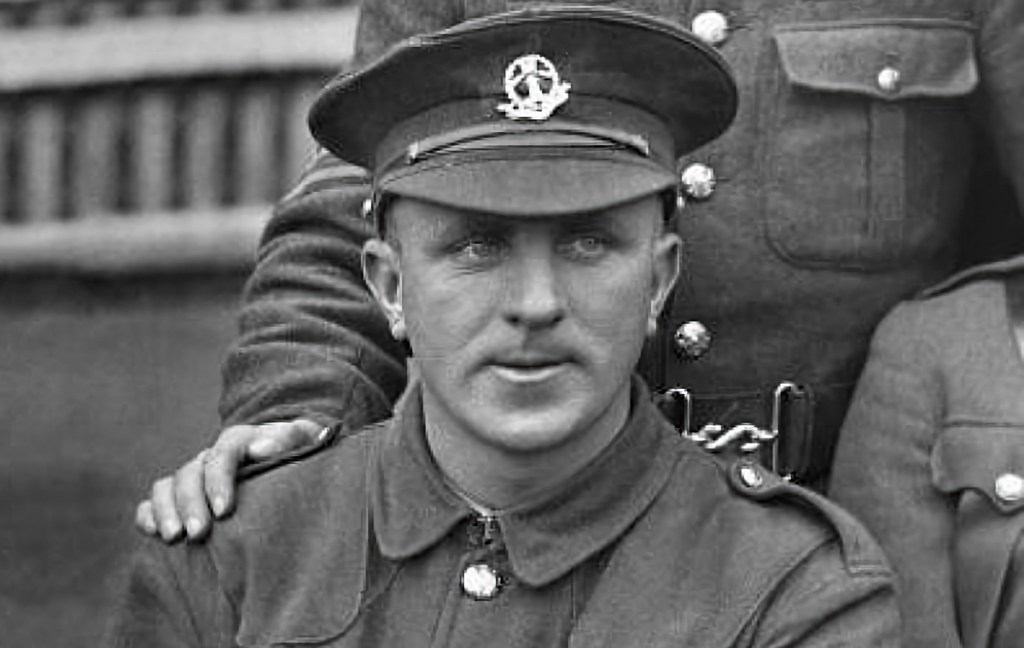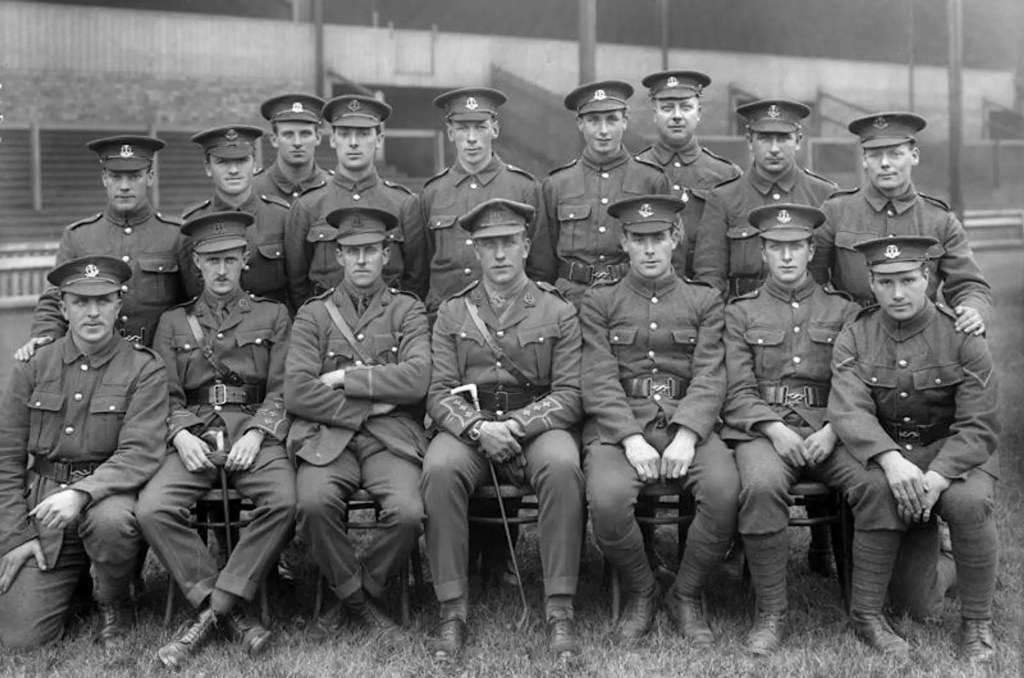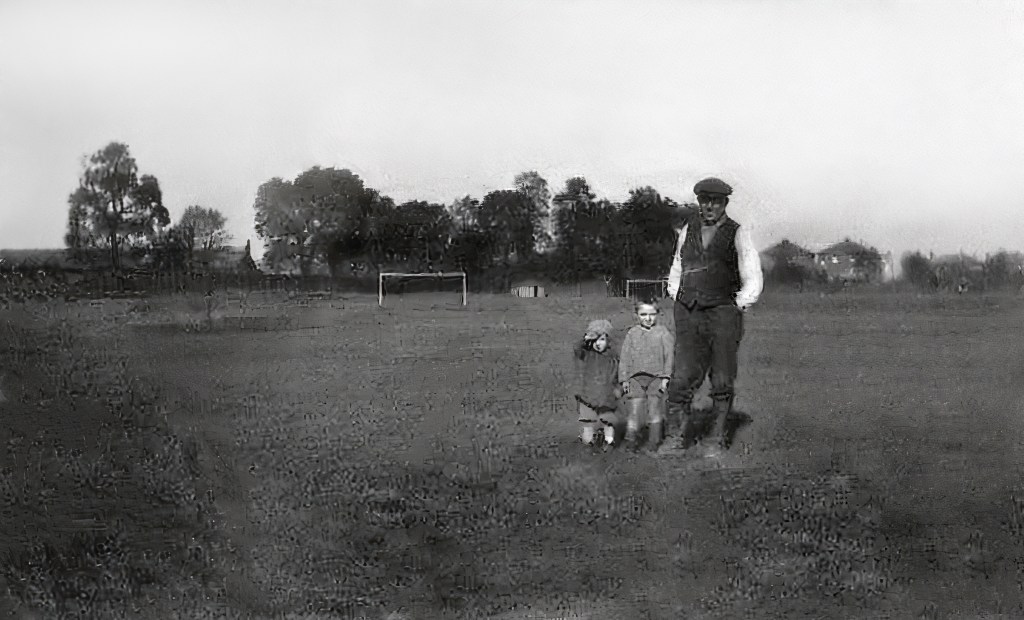
When Patrick Gallacher returned to Ton Pentre after the First World War, he was much more than the club’s captain and centre half. Evidence from contemporary newspapers suggests he was also helping to identify and recruit players for the South Wales club.
One example appeared in the Merthyr Express in October 1919:
“Pat Gallagher (the burly Ton Pentre centre half) was making enquiries about Tim Coleman, and intends making the journey to Ebbw Vale when Ton Pentre visit Ebbw Vale again. He says, ‘Tim is some lad.’”
Merthyr Express, 11 October 1919
Patrick Gallacher already knew Coleman through their service in the Footballers’ Battalion during the First World War.
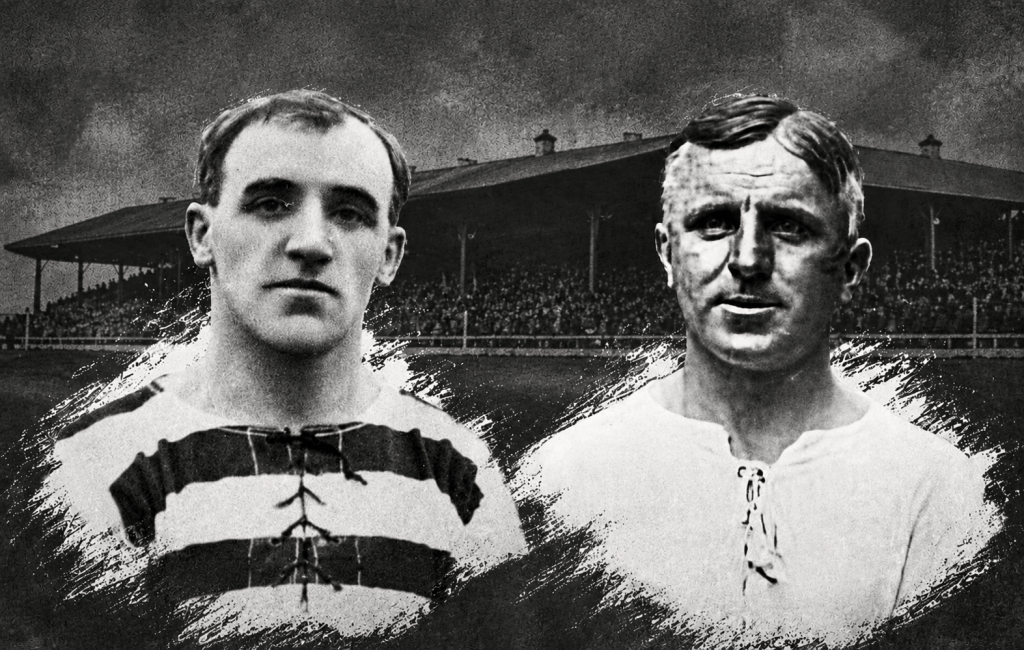
Around the same time, Patrick received an intriguing letter from one of the biggest names in Scottish football, Celtic star Jimmy “Napoleon” McMenemy. The letter was written in response to Patrick’s enquiry about potential players for Ton Pentre.
Letter from Jimmy McMenemy to Patrick Gallacher, 10 October 1919
James McMenemy
Wine and Spirit Merchant.
209 Great Eastern Road,
and 3 Coalhill Street,
Glasgow
10th October 1919
Dear Pat,
Received your letter, and was very pleased to hear you are doing well. In regards to players for your team, it is very hard to run across the sort of men you want. Forwards are a bit scarce here at present, (you can judge, when I am still kicking away) but if I should run across, any player I think will suit you, I will write you at once.
The day I received your letter, I was speaking to D. McDevitt, he says he would like to go up there, but of course you have seen him play, and should know if he will suit you, he is a bit heavier since you knew him, and is looking well. I sent a lad to Blackpool the other week, but I understand they have signed one, there is one inside forward, but a bit light yet, if your letter arrived in time, I would have been pleased to have sent him on to you, however, if I hear or see a good strong lad with a little experience, I will give him a recommendation to you. I will enquire for one or two players, and if they are willing to go, I will write you at once.
I scarcely ever see Arthur now, I think he must be Tee-Tee.
Of course we had a great Mission up here a week or so ago, and it has steadied a few of the Boy’s up for the present,
Trusting this note finds you in the best of Health & Spirits
Yours fraternally
Jas. McMenemy
The letter provides a fascinating glimpse into football’s informal recruitment network in the years immediately after the war. Rather than formal scouting systems, clubs relied heavily on personal contacts and recommendations.
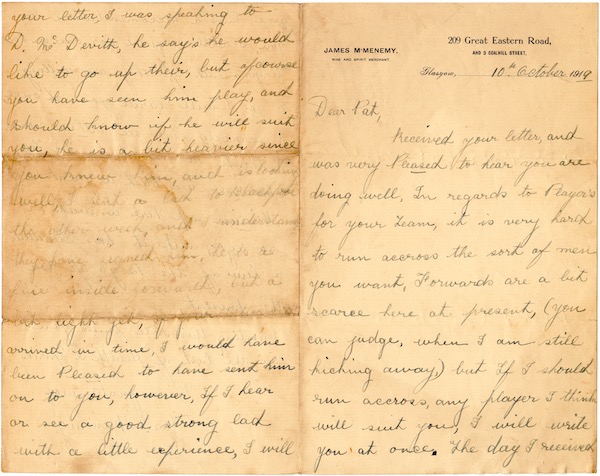
Jimmy McMenemy’s letter to Patrick Gallacher
McMenemy explained that suitable forwards were difficult to find, joking that the shortage could be measured by the fact that he was “still kicking away” himself. At the time he was 39 years old and still appearing for Celtic, an age at which most footballers of the period had long since retired.
The letter also mentions D. McDevitt, a player Patrick had apparently seen in action before, as well as another young inside forward whom McMenemy believed had potential.
One particularly intriguing line concerns Patrick’s brother Arthur:
“I scarcely ever see Arthur now, I think he must be Tee-Tee.”
Arthur Gallacher’s football career occasionally overlapped with that of his brother Patrick. They played together for Duntocher Hibs and later reunited at Barrow AFC during the 1910/11 season. Arthur also spent time with Renton before returning to Glasgow, where he played for Parkhead Forge.
McMenemy’s letterhead gives his address as 209 Great Eastern Road and 3 Dalmarnock Street, Glasgow, the premises of The Duke Bar, which he owned from 1910. Significantly, this was in Parkhead, the same district where Patrick had been born and where his mother was still living in Salamanca Street.
How Patrick Gallacher and Jimmy McMenemy first became acquainted is unknown. Both emerged from Glasgow’s Junior Football scene, and they certainly played against one another during the 1907/08 season when Patrick was with Partick Thistle and McMenemy was starring for Celtic. Whether their friendship dated from that period, or from an earlier connection in Glasgow football, remains uncertain.
What the letter does reveal is that, nearly two decades after leaving Glasgow, Patrick remained connected to influential figures within Scottish football. It also shows him playing an important role at Ton Pentre, helping to identify and recruit players as the club rebuilt in the aftermath of the First World War.
Can You Help?
I would be interested to hear from anyone with information relating to:
- Patrick Gallacher’s role in recruiting players for Ton Pentre.
- The player D. McDevitt mentioned in McMenemy’s letter.
- Evidence of when and how Patrick Gallacher and Jimmy McMenemy first became acquainted.
- Additional correspondence between Gallacher and prominent football figures of the period.
Please visit the Can You Help page if you can add to this story.