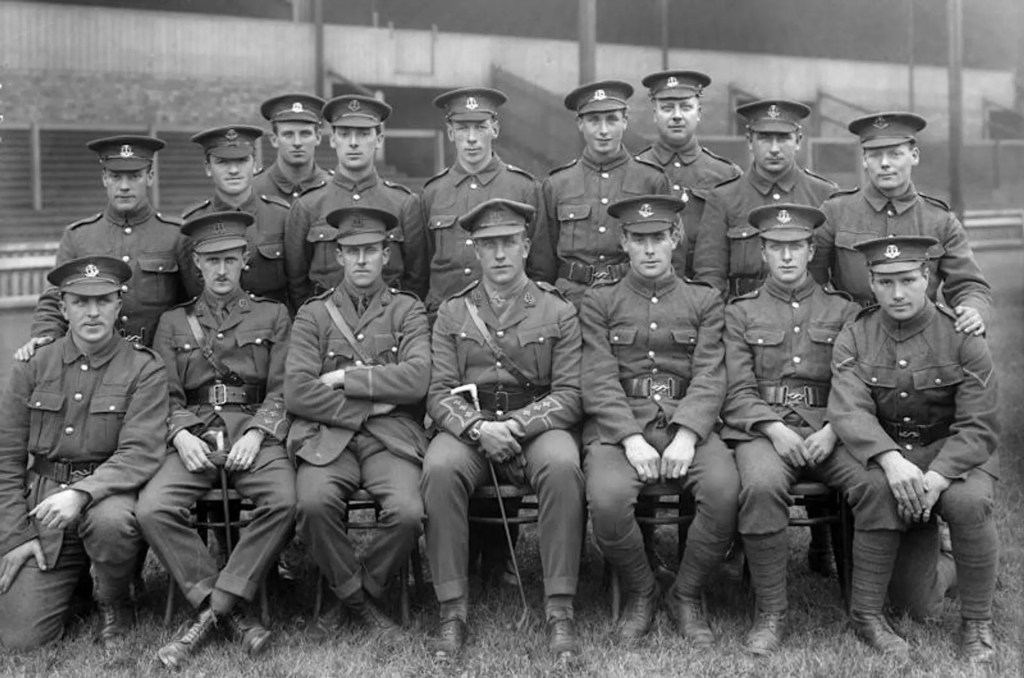
Patrick Gallacher was playing for Ton Pentre AFC when reports emerged that he had enlisted. By January 1915 Britain had been at war for several months, and footballers across the country faced increasing pressure to join the armed forces.
“In Pentre last week 103 were enrolled, including Pat Gallacher, the captain of the Ton Pentre AFC.”
Western Mail, 12 January 1915.
One of Patrick’s last known wartime appearances for Ton Pentre came against Merthyr Town in April 1915.
The Sporting Life reported on Patrick and his teammates’ situation in June 1915:
“The playing members of the Ton Pentre Club are, as to the majority, working on or in the colliery, getting coal that is required for Government purposes. In addition four officially connected with the club are on war work. Patrick Gallagher (a professional) is in the Army, and the following eight amateurs have also joined the Forces:—J. Hathaway, R. Rees, E. Rees, E. Williams, J. L. Roderick, A. Griffiths, E. L. Jones, and D. Williams.”
The Sporting Life, 11 June 1915.
Patrick joined the 17th Middlesex Regiment (Footballers’ Battalion) alongside several of his former Barrow AFC teammates, including Jack Dodds, then of Stalybridge Celtic, and David Kenny, then of Grimsby Town.
Battalion training initially took place at White City. Players were allowed to leave training to return to their clubs on Saturdays, although travel costs had to be met by the clubs rather than the Army.
From late August to the end of October 1915, the Footballers’ Battalion took part in several matches before departing for France. Patrick appears in a postcard photograph, now in my possession, as the trainer of the team. It is likely that he attended many of these matches, which also served as recruiting events.
The Footballers’ Battalion arrived in Boulogne on 18th November 1915. Soon afterwards they were deployed to the trenches around Loos.
Patrick’s Role in the Battalion
From my father’s (Terence Gallacher’s) memoirs:
“He told me that he had to wear a French steel helmet because a British helmet was too uncomfortable for his head. Between battles, he played football. Being fit and a sprinter, he was company runner to the C.O. Colonel Fenwick and a moving target who could run like hell. This was just as well because the company runner had one of the highest casualty rates among the front-line troops.”
In addition to serving as Colonel Fenwick’s company runner, Private Patrick Gallacher prepared pitches and acted as trainer to the battalion football team. While football may seem trivial compared with the realities of trench warfare, organised sport helped maintain fitness and morale whenever circumstances allowed.
According to Terence Gallacher’s memoirs, Patrick learned much of his grounds keeping craft while assisting at Tottenham Hotspur during the close season.
“He was a particular friend of Bill Over who was head groundsman of The Spurs. It is likely that Patrick and Alice would have returned to Tottenham during the summer months and during these visits home, Patrick would have done some work with the Spurs ground staff. He would, by doing this work, have gained knowledge on the requirements of being a groundsman, especially of a football pitch.”
(Bill Over later succeeded his father, John French Over, as Tottenham Hotspur’s Head Groundsman in 1927. During the period described here, John French Over held the position.)
These skills would later prove valuable both during military service and in Patrick’s post-football career.
Football in France
Away from the front lines, the Footballers’ Battalion played football whenever circumstances allowed.
Private Jack Dodds wrote:
“After a few weeks of trench work we arrive at some village for a few days and of course our first thought after a day or so of rest is to fix a game up. Very often a suitable ground is hard to find and to give you an idea the worst grounds at home are very often a croquet lawn to where we play. However our keenness gets over this, and then we play for four or five days running. In fact every man has had enough when our return to the trenches is necessary. Sometimes we have teams waiting for us coming out of the line to try and lower our colours.”
Private John “Jack” Stephenson of Cardiff City also mentioned Patrick in a letter to The Athletic:
“He also mentions that their trainer is none other than Gallagher, the old ‘Spurs warrior,’ who is like a father to us.”
The description is revealing. By 1917 Patrick was one of the older and more experienced professional footballers in the battalion. In addition to his military duties, he appears to have played an important role in maintaining the football side of battalion life and supporting younger players.
The 1917 Battalion Photograph
A postcard photograph from 1917, sent to The Athletic journalist “Tityrus” by Private Jack Dodds, shows a group of surviving professional footballers serving with the battalion.
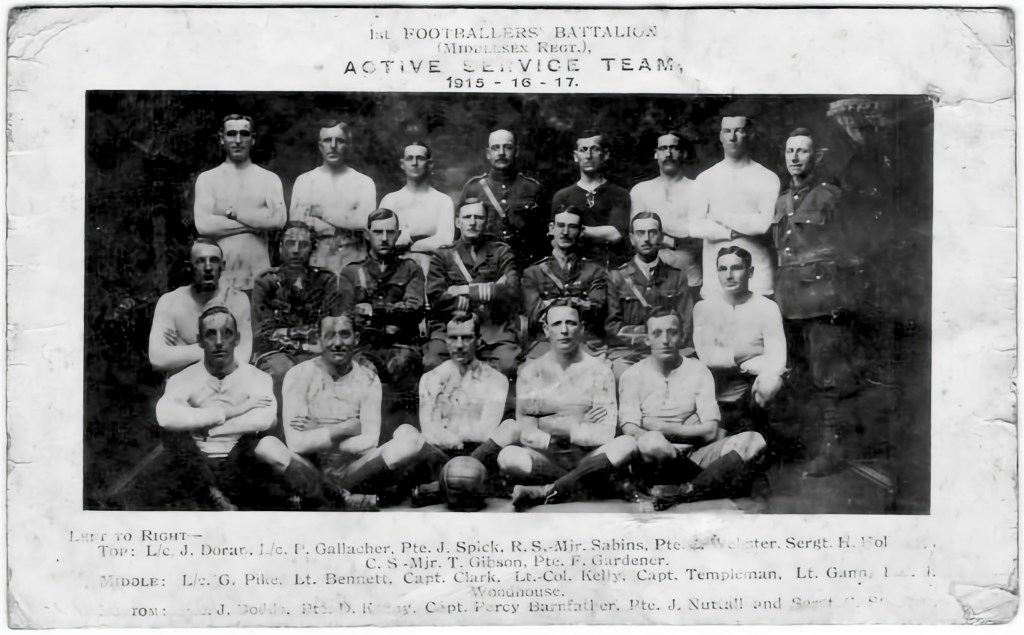
Top row: L/c. J. Doran, L/c. P. Gallacher, Pte. J Spick, R.-S.-Mjr. Sabins, Pte. J. Webster, Sergt. H. Hollanby, C.-S.-Mjr. T. Gibson, Pte. F. Gardener,
Middle row: L/c. G. Pike, Lt. Bennett, Capt. Clark, Lt.-Col. Kelly, Capt. Templeman, Lt. Gamm, Pte. J. Woodhouse,
Bottom row: Pte. J. Dodds, Pte. D. Kenny, Capt. Percy Barnfather, Pte. J. Nuttall, and Sergt. C. Stewart.
In his accompanying letter, Dodds wrote:
“Accept this picture as a souvenir of the war from a few of the old pros. that are left with the battalion. Every player on the photograph has been out here for two years, and although we have had some rough times in that period we still retain very good form when we have an opportunity of a game. Unfortunately this does not happen very often. By this I mean that we don’t get games regularly.”
The Athletic, 5 November 1917.
Without mentioning specific battles or casualty figures, Dodds’ words provide a powerful reminder of what these men had experienced together during two years on the Western Front.
The End of the Battalion
In February 1918, the Footballers’ Battalion was disbanded. Patrick was subsequently transferred to the 28th London Regiment and later the Rifle Brigade.
One of the strongest impressions that emerges from researching the Footballers’ Battalion is the camaraderie that existed between the players. Their shared experience as footballers appears to have strengthened the bonds formed through military service.
Writing shortly after the battalion arrived in France, Colonel Fenwick reflected:
“I knew nothing of professional footballers when I took over this battalion. But I have learnt to value them. I would go anywhere with such men. Their esprit de corps was amazing. This feeling was mainly due to football – the link of fellowship which bound them together. Football has a wonderful grip on these men and on the Army generally.”
Much more remains to be told about Patrick’s wartime experiences, his friendships, and the football played behind the lines, and these stories will be explored in future articles.
Sources
- When The Whistle Blows
- Terence Gallacher’s memoirs
- Contemporary newspaper reports
- Match reports

