Club Overview
Ground: Holker Street
Seasons played: 1910-14
Position: Centre half
Known appearances: 157
Known goals scored: 12
Sources: Peter Lee Hawkridge, Peter Naylor, Terence Gallacher’s memoirs, newspaper articles.
Patrick Gallacher at Barrow AFC
The First Season: 1910-11
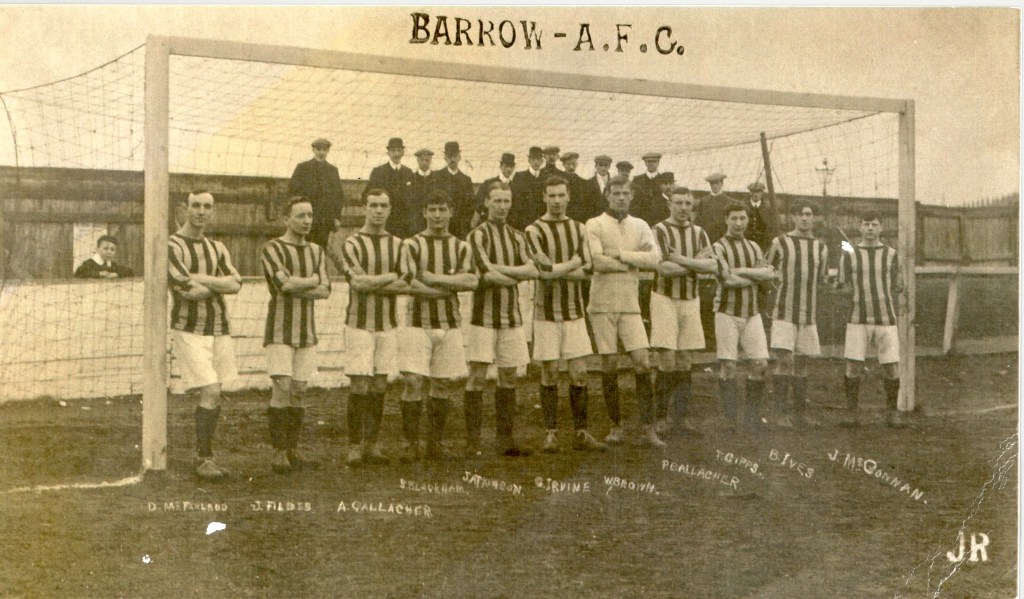
Patrick Gallacher arrived at Barrow AFC in August 1910, becoming club captain at the start of what would prove to be the longest spell of his playing career.
Pat’s brother Arthur, who had played for the Scottish club Renton the previous season, joined Barrow as a forward. It was also the time the forward Ben Ives arrived from Tottenham, he and Patrick would stay in contact decades later.
As debuts go, it was certainly eventful. Barrow’s players, officials and supporters travelled aboard the Lady Moyra to face Fleetwood on 1 September 1910. At one stage Barrow trailed 3-1, but goals from both Patrick and Arthur helped secure a remarkable 4-3 victory.
Tragedy would strike for Patrick and Alice, their second son Albert Patrick Gallacher died in early November, there was a small announcement in the local paper. Match reports noted Patrick was absent from the team due to a family bereavement. “Bertie” was only 2 years old.
Patrick’s combative style was noted by local journalist “Observer”, who at times was Patrick’s biggest champion, but could also be his harshest critic, he wrote:
“I have heard it stated that numerous fouls have been given in away matches against Pat Gallacher. But some referees have queer ideas of what is, and what is not, a fair charge. Players who bob up against Barrow’s burly centre-half, willingly or accidentally, are apt to bounce and imagine they have struck something more solid than a human form.”
Barrow News, 26 November 1910
Patrick’s debut season saw the start of the defensive partnership of him, Jimmy Atkinson and Tommy Gipps.
Over 40 years later, this trio were remembered in Barrow AFC’s “1901-1951 Golden Jubilee Souvenir” handbook.
“Indeed the best half back line Barrow ever possessed and it was a brilliant one was Gipps, Gallacher and Atkinson.”
In the match against Heywood United in December, Arthur too would come in for praise and criticism from “Observer”:
“Arthur Gallacher is a bustling forward and speedy too, but, somehow he fails at the critical moment.
I am inclined to think Gallacher can shoot better with his head than his feet. Some of his “headers” on Saturday were really master strokes”.
In the same game, the Gipps, Gallacher Atkinson line of defence received praise:
“I have not yet seen a trio of half-backs in any (Lancashire) Combination teams to equal our own, so ably led by Pat Gallacher.”
Once on Saturday the Barrow captain took the ball in his own end and ran off with the ball at his toe until he reached the visitors’ end, when his brother Arthur nipped in and made a good attempt to finish the effort. However, Pat looked like scoring himself, and if he had done so it would have been a fitting reward for such a magnificent effort. Atkinson’s play was cool, collected and clever, and Gipps, if, perhaps, not quite so artistic, was none the less effective.”
At the end of the season, Barrow AFC finished second in the Lancashire Combination Division Two and were promoted to Division One.
Establishing Barrow in Division One: 1911-12
The 1911 census provides a snapshot of life away from football. Patrick and Alice, together with Arthur and Catherine, were living in Devon Street. Patrick and Arthur’s occupation was recorded as “Ship’s Plater’s Helper“, illustrating how footballers of the period combined the game with regular industrial employment.
In May, it was reported that Gipps, Gallacher and Atkinson had signed on for the following season. Arthur Gallacher would return to Glasgow with Catherine and his young family and play for Parkhead Forge the following season.
“Observer” wrote in May:
“It will gratify local soccerites to know that Pat Gallacher, who is an ideal captain and an ideal player, has re-signed for Barrow.”
Barrow Herald, 6 May 1911
Patrick’s growing standing in Barrow extended beyond Lancashire Combination football. In May 1911 he refereed a schoolboy match between Oxford Street and Barrow Island at Holker Street. Fellow Barrow player Sam Blackman acted as a linesman, demonstrating the close links that existed between the football club and wider community life.
The 1911/12 season began and by then Patrick Gallacher had proven himself as Barrow captain and a crucial cog in the defence with Gipps and Atkinson. Ben Ives also returned.
After two draws, Barrow met Haslingden at home, Patrick facing his old Workington teammate Bob Ellis. Barrow won comfortably 3-0.
Barrow would narrowly lose to Bolton Wanderers in the Lancashire Senior Cup and at the end of the year, lose 2-1 to Watford in an FA Cup replay.
With Patrick established as captain and the half-back line continuing to perform strongly, Barrow finished fourth in the Lancashire Combination Division One. The club recorded 15 wins, 9 draws and 8 defeats from 32 matches, collecting 39 points.
The close season brought significant changes. Tommy Gipps departed for Manchester United, bringing an end to the celebrated Gallacher-Gipps-Atkinson partnership. At full-back, Thomas McKenna arrived from Burnley to strengthen the defence. Ben Ives would leave for Exeter City.
The 1912-13 Season
By early October the new line up was already showing promise:
“Barrow have earned the distinction of heading the Combination table, and of playing their first six League matches without a solitary defeat.
September has been a bright and sunny month for the Barrow club, local enthusiasm has been stirred to an unprecedented degree, outside critics have sung our praises.”
“Observer”, Barrow News, 5 September 1912
Thomas McKenna was gaining a good reputation in the defence, in subsequent matches, while “Pat Gallacher was the “Pat” we know him to be”, according to Barrow News.
Their first ‘reverse’ was to be a defeat against Manchester City in October, in the Lancashire Cup, played at City’s Hyde Road ground. The Barrow Herald reported that, “Barrow lost by 2-1, but defeat was never more undeserved.’
In November, David Kenny arrived from Falkirk, as a centre forward, according to reports. He’d soon get on the scoresheet, such as the 10-0 trouncing of Rossendale in early December.
Barrow’s next game on the 14th was Trowbridge away in the FA Cup, Barrow offered them £75 so the match could be played at Holker Street, but Trowbridge declined. Trowbridge prepared for a record crowd.
In a match preview, The Wiltshire Times, commented on Patrick Gallacher.
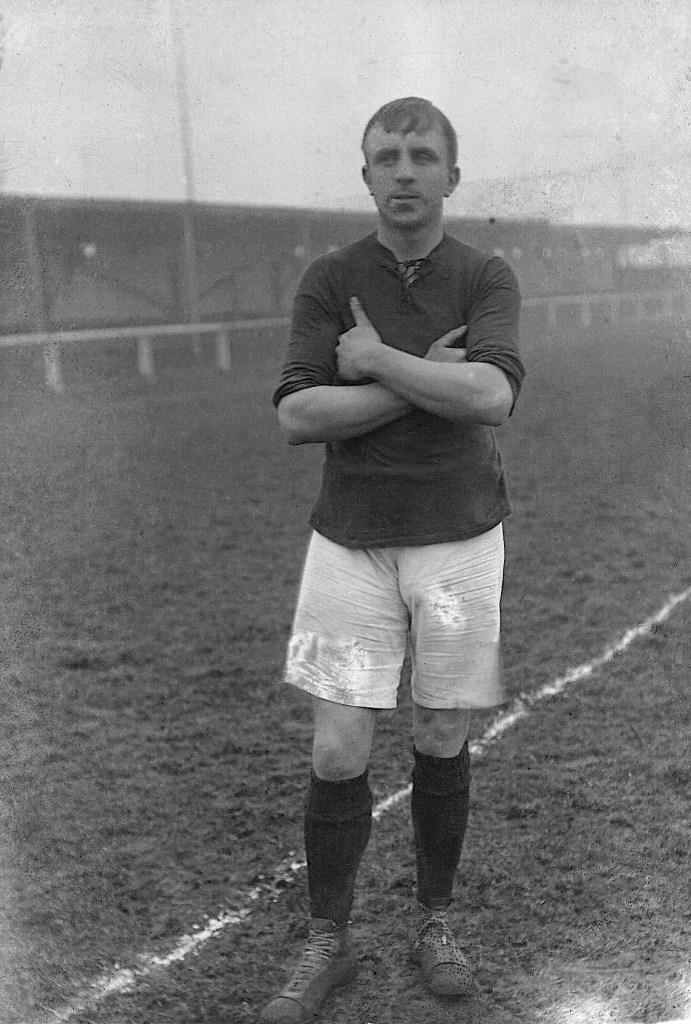
“He is the heaviest man in the team, ripest in experience. A stalwart defender in every respect, and clean and accurate in his methods.”
Barrow won 4-1, David Kenny scoring a hat-trick. The victorious team finally arrived at Barrow Central Station from their train journey at 5.45am Sunday morning greeted by one of the directors.
Barrow drew 1-1 with Bradford Park Avenue in the FA Cup before accepting £650 to switch the replay to Bradford. The controversial replay ended in a 2-1 defeat, with Barrow protesting that the winning goal had been scored after time had expired. The tie would prove one of the most significant episodes of Patrick’s time at Barrow and will be explored in a dedicated article.
When Barrow visited Nelson in February, McKenna returned, but it was decided for Patrick Gallacher to remain at full back and McKenna play right-half-back.
Barrow’s incredible long unbeaten run at Holker Street ended in the game against Walkden at the start of February, the first defeat since January 15th 1910. “Observer”, wrote that Patrick Gallacher was “below form”, but also, “None of the Barrow players covered themselves in glory”. It was the first of four consecutive defeats.
“Observer” reporting on the 2-3 loss to Altrincham said, “Gallacher was not safe in that position (full back) but there was a great improvement when McKenna took up that position”. What hadn’t been explained, is why both Patrick and McKenna were both playing out of position at the start of the match.
Patrick would be rested for the return fixture a week later.
Patrick Gallacher would return at centre half against Leicester Fosse, albeit a friendly, and score in a 3-1 win.
In March, the North West Evening Mail, published an amusing article with one liners about the Barrow players, the one for Patrick read:
“Pat Gallacher has become an expert chauffeur: He also excels in postprandial oratory.”
Barrow AFC ended the season in 5th place in the Lancashire Combination Division One.
The earlier decision to accept Bradford’s offer of £650 to play the FA Cup replay at Park Avenue, rather than Holker Street, proved transformative financially. At the club’s end-of-season gathering at the Criterion Restaurant, President Fred Newman, reportedly burned the club’s £320 overdraft agreement in front of the assembled members, prompting applause.
The Cricket and Football Field, in an end of season roundup, said, David Kenny and Tommy McKenna had “thrown in their lot with Bradford City”. In fact, they both moved to Grimsby Town with the lack of summer wages at Barrow AFC rumoured to be a reason.
The 1913-14 Season
This would be a season of change; Barrow AFC appointed a new manager John Parker in August. From last season’s team only Patrick Gallacher (who was “re-elected” captain), Jimmy Atkinson, John Woods and “Daisy” Bell were retained.
“Only four of last season’s regular Combination team have been retained, namely “Pat” Gallacher (who is already in fine form and intends to show his critics that there is a lot of good football in him yet). “Daisy” Bell, who, like “Pat”, has fought man hard battles – always in the firing line – Jimmy Atkinson. an old servant and a trusty one, and Johnny Woods, a hard and strenuous forward.”
“Observer”, Barrow News, 30 August 1913.
Many of the departing players had been snapped up by bigger clubs, Barrow weren’t able to compete financially, by, as an example, offering Summer wages.
Among the many new players, described in the Barrow News as a “Galaxy of talent”, was John Thirlwell “Jack” Dodds, from Oldham, a forward. Dodds would later meet up with Patrick Gallacher in the Footballers’ Battalion.
The team gelled in their opening match against Accrington Stanley, winning 4-0 at Holker Street.
In December, Patrick missed preparations for the cup match away at Stoke, due to the death of his sister Elizabeth. Stoke would go on to win 3-1.
Up to Christmas Day, Barrow had only lost twice, this was followed by a run of defeats, starting with a 2-1 defeat at South Liverpool on Boxing Day, where it was reported the crowd booed Barrow for ’rough play’ and were escorted off the field at full time by the police and officials.
Following a 3-1 defeat against Atherton in April, which was perhaps the last chance to still be in contention of the Championship, captain Patrick Gallacher was suspended, according to the Daily Citizen (Manchester). ”Daisy Bell” was relegated to the reserves and three other players were to appear “on the carpet to clear accusations’.
The interesting point is this was reported in a Manchester newspaper, but I couldn’t find a mention of a suspension in any of the local Barrow Newspapers.
The Barrow Herald and Furness Advertiser did say that “There are one or two changes in the home side, Gallacher and Bell being rested” for the next game. There were only two more Lancashire Combination games to follow.
Patrick would return for the last game against Heywood, beating them 5-0, leaving the field after a clash of heads. Barrow AFC would finish second in Division One Lancashire Combination, seven points behind Tranmere but seven more points than the previous season.
In late April, ”Observer”, in an editorial, foretold a possible reason for Patrick’s departure from Barrow AFC:
“As Barrow will be in the Combination at least another season, I think I am right in saying that less professionals will be engaged, and the wage bill cut down as much as possible.”
Barrow News, 25 April 1914.
In the summer of 1914 Patrick left Barrow to join Ton Pentre in South Wales, bringing to an end four eventful years at Holker Street.
Legacy
Patrick’s four years at Barrow represented the longest uninterrupted spell of his football career. During his time at Holker Street, he captained the club, experienced both family joy and tragedy, worked in the shipyards, formed lasting friendships and became one of the most respected captains in the Lancashire Combination”.
By the summer of 1914, however, financial realities once again shaped the future of many players, and Patrick moved to Ton Pentre in South Wales, bringing an important chapter of his life to a close.
Related pages

